Removing old paint is often one of the most time-consuming parts of restoring woodwork, historic homes, doors, windows, and furniture. Traditional methods can involve chemical strippers, sanding, or high-temperature heat guns, but there is another option worth understanding: infrared paint removal.
Infrared paint removal uses controlled infrared heat to soften layers of old paint and help loosen their bond with the surface underneath. Once softened, the paint can be removed with an appropriate scraper, making this method especially useful for wood restoration and projects where preserving the underlying material matters.

Sanding, chemical paint strippers, heat guns, and traditional scraping all have their place. But for many restoration projects, another option deserves serious consideration: infrared paint removal.
Infrared paint removers use controlled heat to soften layers of paint so they can be lifted away with a paint scraper. Instead of relying on aggressive sanding or chemicals alone, infrared technology can make old coatings easier to remove while giving the person doing the restoration greater control over the process.
At Eco-Strip, paint removal isn’t simply about getting paint off a surface. It is about choosing the right combination of heat, paint scrapers, techniques, and restoration tools for the material you’re trying to preserve.
What Is Infrared Paint Removal?
How Does Infrared Paint Removal Work? Infrared paint removal uses infrared heat to warm painted surfaces and soften the bond between layers of paint and the substrate underneath.
Once the paint has softened, it can be removed using an appropriate paint scraper.
The basic process is straightforward:
Heat. Soften. Scrape. Restore.
Rather than repeatedly scraping hard, cold paint, the infrared paint remover prepares the coating for mechanical removal.
This is particularly useful when dealing with multiple layers of old paint.
Depending on the surface, coating, and number of layers, softened paint may lift in sections rather than breaking into the small chips commonly produced when scraping brittle paint.
The result can be a more controlled paint-removal process and a surface that is ready for the next stage of restoration.
Infrared Paint Remover vs. Heat Gun: What’s the Difference?
Although both tools use heat, an infrared paint remover and a conventional heat gun do not work in exactly the same way.
A heat gun produces a concentrated stream of very hot air. That can be useful for many applications, but it also requires careful movement and temperature control.
An infrared paint remover uses infrared energy to heat a broader area of the painted surface rather than directing a narrow stream of hot air at one point.
For restoration work, that difference can be important.
The objective isn’t simply to make paint as hot as possible. The goal is to soften the coating enough to make it easier to separate from the surface underneath.
Regardless of the method being used, old painted surfaces require appropriate precautions—particularly when the age or composition of the coating is unknown.
Why Infrared and Paint Scrapers Work So Well Together
An infrared paint remover is only one half of the process.
The other half is the paint scraper.
Once paint has softened, the scraper does the mechanical work of lifting it from the surface. Choosing the correct scraper can make just as much difference as choosing the heat source.
A wide flat scraper may work well across siding or a large door.
A smaller scraper gives better control around trim and narrow wood components.
A profile scraper can follow curves, grooves, molding, and decorative architectural details.
Window restoration may require small blades, putty scrapers, or specialized tools for working around muntins and glazing.
This is why we think about paint removal as a system rather than a single tool.
Heat + the right scraper + good technique = better paint removal.

Removing Paint From Old Wood
Old wood deserves a different approach from disposable modern materials.
A historic door, original clapboard, century-old window sash, or piece of architectural trim cannot simply be replaced without losing something.
In many cases, the imperfections are part of its history.
When removing paint from old wood, the goal should therefore be more than exposing bare material as quickly as possible. You want to remove the unwanted coating while preserving as much of the underlying wood and original detail as practical.
This is one reason infrared paint removal has become useful to people working on older properties.
Once the paint is softened, a properly selected scraper can remove the coating with less dependence on aggressive mechanical abrasion.
That can be especially valuable when the project contains details that you want to preserve.
Using Infrared Paint Removal on Siding
Wood siding is one of the most demanding paint-removal projects because of the amount of surface area involved.
A house may have multiple generations of paint, with some sections adhering well and others already cracking or peeling.
Trying to remove all of that with a small hand scraper alone can become exhausting.
For larger areas, infrared heat can be used to soften a section of coating before scraping. The work can then progress systematically across the siding.
The scraper matters here as well.
Broad, relatively flat surfaces generally benefit from a scraper designed to cover more area efficiently. Smaller tools can then be used around trim, edges, corners, and architectural details.
Instead of expecting one tool to perform every task, the process becomes a sequence of tools working together.

Old wood doors are excellent candidates for careful restoration because they frequently contain high-quality wood and craftsmanship that can be difficult or expensive to reproduce.
They can also contain a surprising number of paint layers.
A door that appears relatively simple may include broad panels, rails, recessed areas, molding, corners, and detailed profiles.
This makes it a perfect example of why both infrared heat and scraper selection matter.
A larger scraper can address flat areas after the coating has been softened, while smaller and profile-shaped blades can work around recessed panels and molding.
Instead of treating the entire door as one surface, approach each section according to its shape.
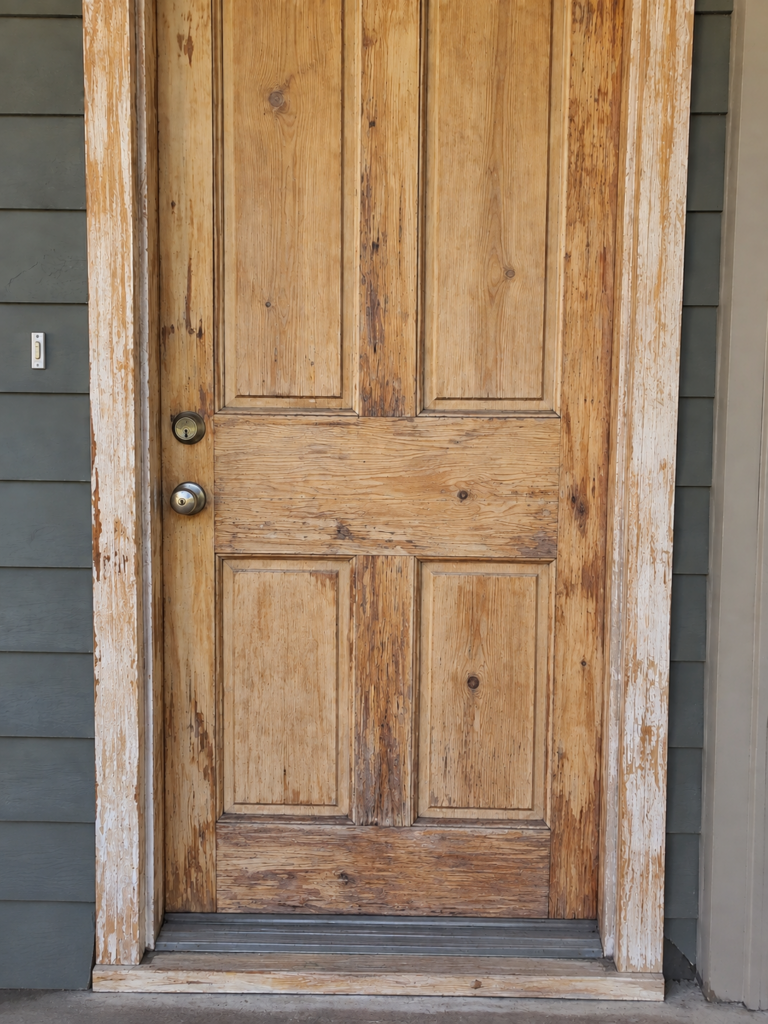
Used infrared Paint remover to scrape old paint off good-quality wood doors.
Restoring Old Wood Windows
Historic wood windows present an even greater challenge.
A traditional sash may contain narrow muntins, profiles, corners, glazing material, glass, and multiple painted surfaces within inches of one another.
Control is essential.
Smaller infrared paint-removal tools can be particularly useful when working in detailed areas because they allow the user to concentrate on manageable sections.
The same principle applies to scraping.
Large blades are not always better. Around window components, smaller scrapers and specialized profile blades can provide substantially greater control.
Window restoration is a good example of an important rule:
Match the tool to the surface—not the surface to the tool.

What About Detailed Trim and Architectural Woodwork?
Baseboards, columns, molding, decorative trim, and architectural millwork are often where traditional flat scrapers reach their limits.
A flat blade cannot properly follow every curve.
Trying to force the corner of a flat scraper into a decorative profile can damage details that have survived for decades or even centuries.
This is where profile and contour scrapers become valuable.
Different blade shapes can reach edges, corners, concave surfaces, convex profiles, and narrow details.
After infrared heat softens the coating, the appropriate profile scraper can follow the shape more naturally.
This combination is particularly useful for restoration work because the objective isn’t simply paint removal.
It’s preservation.


The exact process depends on the substrate, coating, condition of the material, and final finish you plan to apply.
Choosing an Infrared Paint Remover
Not every restoration project requires the same infrared tool.
When comparing infrared paint removers, consider:
- Heating-area size
- Tool dimensions and weight
- Wattage
- Shape of the heating surface
- Type of project
- Size of the area being stripped
- Accessibility of corners and details
- Available scrapers and accessories
- Replacement parts and support
- Budget
A larger heating area can be useful when stripping broad surfaces. A smaller tool can provide better access when working around windows, furniture, trim, and detailed architectural elements.
For someone who regularly restores different types of surfaces, there may not be one infrared tool that is ideal for every project.
The important question isn’t:
“Which infrared paint remover is the best?”
It is:
“Which infrared paint remover is right for the work I’m doing?”
Building a Better Paint-Removal Tool Kit
One of the biggest lessons we’ve learned from working with people who restore old houses is that successful paint removal rarely comes down to one miracle tool.
The better approach is to build a system.
A well-equipped paint-removal kit may include:
- An infrared paint remover
- A general-purpose paint scraper
- Detail and profile scrapers
- Window and glazing tools
- Protective gloves
- Appropriate respiratory protection
- A heat-resistant work surface or mat
- Tools for final surface preparation
What belongs in your kit depends on whether you’re restoring siding, windows, doors, furniture, porches, columns, or interior woodwork.
That is why Eco-Strip focuses not just on paint-removal machines, but on the complete process of removing paint and restoring the material underneath.
Paint Removal Is Only the Beginning
There is an important distinction between paint removal and restoration.
Paint removal asks:
“How do I get this coating off?”
Restoration asks:
“How do I remove this coating while preserving what is underneath and preparing it for another generation of use?”
That second question changes the tools you choose and the way you work.
Sometimes speed matters.
Sometimes precision matters more.
Sometimes you need a broad scraper and a large heating area. Other times you’re working inches away from glass on a narrow piece of historic window sash.
There is no single tool for every situation.
There is, however, a better approach: understand the material, understand the coating, soften the paint appropriately, choose a scraper that matches the surface, and work with the original material rather than against it.
Eco-Strip: Tools for Paint Removal and Restoration
Eco-Strip was built around a simple idea: old materials are often worth saving.
That is why our focus extends beyond any single paint remover, scraper, or manufacturer.
We specialize in infrared paint removal, paint stripping tools, scrapers, window restoration tools, and accessories for people who would rather restore than replace.
Our selection includes infrared paint removers for different types of projects, specialized paint scrapers and profile blades, window restoration tools, glazing products, protective equipment, and other tools designed to make restoration work more manageable.
Just as importantly, we want to help people understand how and when to use them.
Because the best restoration tool isn’t necessarily the biggest, hottest, or most expensive.
It’s the one that helps you do the job while preserving what made the piece worth restoring in the first place.
Restore More. Replace Less.
Whether you’re uncovering an original wood door, bringing old windows back to life, stripping decades of paint from clapboard siding, or carefully working around the profile of historic molding, the principle remains the same:
Remove what doesn’t belong without unnecessarily damaging what does.
Infrared paint removal is one tool that can help make that possible.
Pair it with the right scraper, the right technique, and the right restoration tools, and paint stripping becomes more than simply removing old coatings.
It becomes the first step in bringing something worth saving back to life.